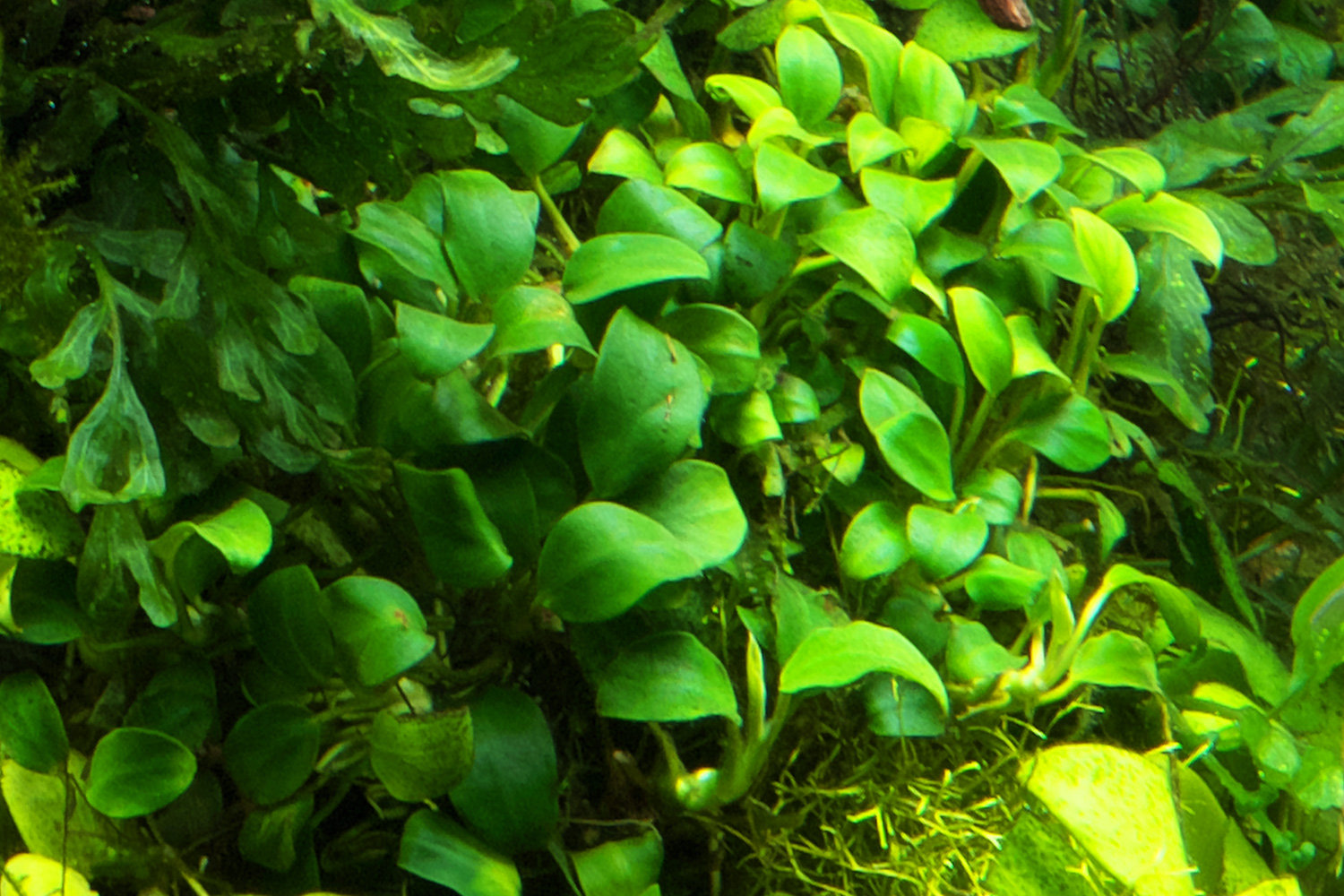
A yellow leaf is one of the most common sights in a young planted tank — and one of the most misread. Beginners often reach for a random bottle, dose everything at once, and learn nothing except that the yellowing continues. The plant, meanwhile, has been giving a fairly precise report the whole time. A leaf can only yellow in so many ways, and where the yellow appears is a map to why it appeared. Learn to read that map and most cases solve themselves.
Read the pattern first: old or new, whole leaf or in-between
Plants manage shortages by moving nutrients around. Some nutrients are mobile — nitrogen, phosphorus, potassium and magnesium can be pulled out of old leaves and sent up to feed new growth. When a mobile nutrient runs short, the plant sacrifices its oldest leaves first, so the damage shows at the bottom of the plant while the tips keep growing. Other nutrients, like iron, are immobile: once built into a leaf they cannot be moved. When iron runs short, the older leaves stay green and the new growth comes in pale, because there is nothing spare to build it with.
That single distinction — old leaves first or new leaves first — cuts the suspect list in half before you test or dose anything. Add two more observations and you are most of the way to a diagnosis:
- Which part of the leaf? Even yellowing across the whole leaf points one way; yellowing between veins that stay green points another; yellowing that starts at the edges and margins points a third.
- What changed recently? A new plant, a new light, a CO2 cylinder that ran empty, a fertiliser routine you quietly stopped — yellowing that follows a change is usually about the change.
The 7 causes of yellowing leaves
1. Nitrogen shortage — the classic
The most common cause of all. Older, lower leaves turn a fairly even pale yellow, sometimes becoming translucent, while growth overall slows and the plant looks thin and hungry. The plant is stripping nitrogen from old leaves to keep the growing tips alive. It happens in lightly stocked tanks, in tanks with a lot of fast-growing plants, and in any tank where the fertiliser routine includes everything except a nitrogen source. The fix is a complete fertiliser routine that actually supplies nitrogen, keeping nitrate in the usual planted-tank range of roughly 10–20 ppm rather than chasing zero.
2. Iron shortage — the pale new growth
The mirror image of nitrogen. Here the newest leaves emerge pale yellow or almost white, often with the veins staying greener than the tissue between them. Because iron cannot be recycled from old leaves, a shortage shows immediately in fresh growth. Red plants losing their colour is another frequent clue. The fix is a comprehensive trace-element (micronutrient) fertiliser dosed consistently — iron is used in tiny amounts but must actually be present, and it does not store well in the water, so regular small doses beat occasional big ones.
3. Magnesium shortage — yellow between green veins, on old leaves
Magnesium produces the same between-the-veins yellowing as iron, but on older leaves, because magnesium is mobile and the plant raids old tissue first. It is most likely in very soft water — tanks filled with RO water or naturally soft tap water, where there is little magnesium to begin with. The fix is to supply magnesium as part of your remineralising or fertiliser routine (Epsom salt, magnesium sulphate, is the simple source many keepers use). If the yellowing-between-veins is on new leaves, think iron; on old leaves, think magnesium.
4. Potassium shortage — and its overlap with nitrogen
Potassium also strikes older leaves first, but it adds signatures nitrogen does not: yellowing that concentrates at the edges and margins, and small pinholes that can widen into ragged holes. The overlap confuses people — both shortages yellow old leaves, and both can appear together, since both come from an incomplete fertiliser routine. Look for the edges and the pinholes: they are potassium’s fingerprints. (Our companion guide on holes in aquarium plant leaves goes deeper on that pattern.) Many nitrate fertilisers are potassium-based salts, so fixing nitrogen often lifts potassium too — one reason a complete routine beats single-nutrient guessing.
5. Too little light reaching the leaf
Not every yellow leaf is hungry. Lower leaves that are progressively shaded — by the plant’s own upper growth, by taller neighbours, or by floating plants spreading overhead — yellow, thin out and drop, because keeping a leaf that cannot photosynthesise costs more than it earns. The plant is pruning itself. Check whether the yellowing is only in the shadows while the lit tops look perfect. The fix is mechanical, not chemical: trim stem plants and replant the tops, thin floaters, or move the plant somewhere the light actually reaches.
6. Unstable CO2 in injected tanks
If you inject CO2, swings in supply can yellow plants even when fertiliser is present. A cylinder running low, a timer drifting, a new filter changing surface agitation — any of these can make CO2 plentiful one day and scarce the next, and plants respond with stalled growth and yellowing, sometimes with distorted new leaves. The nutrients are in the water; the plant just cannot use them steadily without carbon. The fix is consistency: CO2 on before the lights every day, at a stable level (roughly 30 ppm is the common target, monitored with a drop checker), and a cylinder you replace before it runs dry.
7. Transplant adaptation — the false alarm
Most aquarium plants are grown out of water at the nursery, because they grow faster that way. Submerged in your tank, the old air-grown leaves cannot work underwater, so they yellow, go transparent or melt away over the first few weeks while the plant grows proper underwater leaves from the crown or rhizome. This is not a deficiency and no fertiliser will stop it. Cryptocoryne are famous for it, but most species do it to some degree. If you can see fresh growth coming in, the plant is adapting, not dying: remove leaves as they fully give up, and leave it alone.
The quick diagnostic table
Match your pattern against this table, then confirm with the detail above before you act.
| Pattern you see | Likely cause | First fix |
|---|---|---|
| Old leaves yellow evenly, whole plant pales, growth slows | Nitrogen shortage | Dose a complete fertiliser with nitrogen; keep nitrate around 10–20 ppm |
| New leaves pale or yellow, veins stay greener | Iron shortage | Dose a comprehensive trace fertiliser, consistently |
| Old leaves yellow between veins that stay green | Magnesium shortage | Check your water is not too soft; add a magnesium source |
| Old leaves yellow at edges, with pinholes or ragged holes | Potassium shortage | Dose potassium as part of a complete routine |
| Only the shaded lower leaves yellow; tops are healthy | Light not reaching them | Trim and replant tops; thin floating plants |
| Yellowing plus stalled growth in a CO2-injected tank | Unstable CO2 | Stabilise timing and level; check the cylinder and drop checker |
| New plant (first few weeks), old leaves yellowing but fresh growth visible | Transplant adaptation | Nothing — prune dead leaves and wait |
Fixing it safely: adjust one thing at a time
Once the pattern points at a cause, correct it the boring way. Bring dosing up to a complete, consistent routine — a proper all-in-one or a macro-plus-trace schedule — rather than mega-dosing the single nutrient you suspect. Most yellowing comes from routines with a gap in them, and a complete routine closes the gap without overshooting somewhere else. Our planted tank fertilizer guide lays out how the pieces fit together. If you run a low-tech tank without injected CO2, keep doses modest and steady, as the low-tech planted tank guide explains — slow growth needs less food, but it still needs all of it.
Support the fix with the basics: a weekly water change in the region of 25–50% keeps nutrients from accumulating unevenly and resets the water chemistry, and testing nitrate once while you diagnose confirms whether it really is sitting near zero or comfortably in range. Then change nothing else for about two weeks. Plants respond on plant time.
What recovery actually looks like
Set your expectations correctly, because this is where many beginners give up on a fix that was working: a fully yellowed leaf does not turn green again. The leaf’s chlorophyll is gone and the tissue is being retired by the plant. Recovery is written in the new growth — fresh leaves emerging green, properly coloured and full-sized over the following one to two weeks (longer for slow growers like Anubias, which may only produce a leaf every few weeks).
So judge the plant at the tips, not at the base. Once new growth looks right, prune the leaves that are mostly yellow or dissolving — they are shading the plant and feeding algae as they decay — and let the plant put its energy into the new leaves. A plant that is producing clean new growth while its oldest leaves fade is not getting worse. It is recovering, in the only order plants know how.