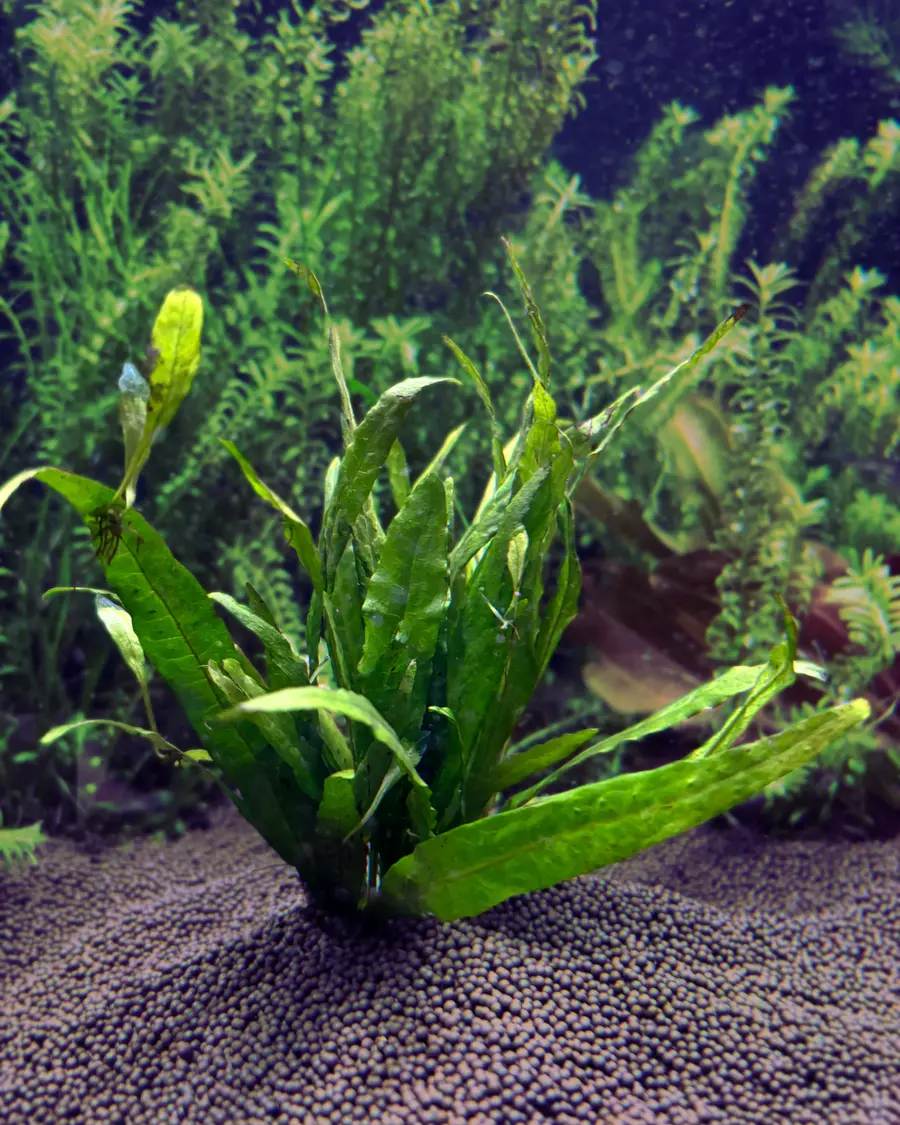
“Root tabs or liquid fertilizer?” sounds like a contest, but healthy planted tanks rarely treat it as one. The better question is: where does each plant actually eat? Put the food in the wrong place and a plant can sit in a tank full of nutrients while still going hungry. Put it in both places, in modest and consistent amounts, and most beginner setups become much easier to read.
How aquarium plants actually feed
Aquatic plants are not split neatly into root-only and leaf-only feeders. Most can absorb nutrients through both roots and leaves; what changes is the proportion. A plant with a large root system in the substrate can draw heavily from that zone. A plant attached to wood has no meaningful access to substrate food, so the surrounding water is its pantry. Tropica makes the same practical point: nutrients can be supplied in the water or in capsules because aquarium plants can take up macronutrients through roots and foliage, but liquid feeding is essential for moss, floating plants and plants growing on rocks or wood.
Roots do more than absorb. They anchor the plant, explore the substrate and create a small living zone where microbes help cycle nutrients. Leaves and stems are surrounded by water, so they can take dissolved nutrients directly from the column. As a stem plant is trimmed and becomes bushy, its upper growth may rely more on the water than the original buried stem does. That is one reason a tank can change its appetite as it matures.
Carbon sits above all of this. Plant tissue is built mostly from carbon, and even a perfect fertilizer cannot compensate for carbon that is too low for the light being used. If you run injected gas, read our guide to CO2 for planted tanks alongside this one: stable carbon delivery is the foundation that lets fertilizer do useful work.
Which plants lean on roots, and which lean on the water?
Use these groups as tendencies, not rigid laws. Species, substrate, flow and planting style all shift the balance.
| Plant type | Typical examples | Best feeding emphasis |
|---|---|---|
| Heavy root-leaning plants | Amazon sword (Echinodorus), Cryptocoryne, Vallisneria, tiger lotus, dwarf sagittaria | Nutrient-rich substrate or root tabs, plus a light-to-moderate liquid dose for foliage and trace elements. |
| Flexible feeders and stems | Rotala, Ludwigia, Hygrophila, Bacopa | Both routes. They root in the substrate but absorb readily from the water, especially as branching tops grow away from the base. |
| Rhizome plants / epiphytes | Anubias, Java fern, Bucephalandra, Bolbitis | Liquid fertilizer. Attach to hardscape and keep the rhizome exposed; do not bury the rhizome in substrate. |
| Mosses and floating plants | Java moss, Salvinia, Amazon frogbit, red root floater | Liquid fertilizer only. They have no useful feeding roots in the substrate. |
The rhizome rule
Anubias and Java fern grow from a thick horizontal stem called a rhizome. Leaves rise from it and roots grow downward from it. Those roots may anchor into cracks or substrate, but the rhizome itself should sit above the substrate, tied or glued to wood or stone, or wedged into a gap. Aquarium Co-Op gives a useful planting trick if you want the roots in the ground: push the plant down, then gently pull upward until the rhizome rests on top while the roots remain buried. Burying the whole rhizome is a common beginner mistake and can lead to rot.
Rooted rosettes are different. A sword plant or crypt has a crown where leaves meet roots. That crown normally sits at about substrate level, with roots below. Do not confuse “do not bury the rhizome” with “leave every plant floating.” Each growth form has its own correct planting depth.
What the nutrients actually do
Fertilizer labels look like alphabet soup until you connect each element to a job. The 2Hr Aquarist’s nutrient guide is a good reference point because it separates the major elements from traces without pretending one bottle fixes every problem.
Macronutrients: N, P and K
- Nitrogen (N) is part of chlorophyll, amino acids, proteins, enzymes and nucleic acids. It strongly affects growth rate and green growth. Plants receive it in the tank mainly as nitrate (NO3) from fertilizer, fish waste and food.
- Phosphorus (P), dosed as phosphate (PO4), is used in DNA, RNA, cell membranes and ATP—the energy-transfer molecule. It is easy to under-dose in a densely planted tank if the fertilizer is mostly a trace mix.
- Potassium (K) supports enzyme activity, photosynthesis, protein synthesis and the movement of water and sugars through the plant. It is mobile inside the plant, so shortages often appear first in older leaves. The classic warning sign is yellowing with pinholes; our guide to holes in aquarium plant leaves explains how to check that pattern properly.
Secondary nutrients and micronutrients
Magnesium (Mg) sits at the center of the chlorophyll molecule, while calcium and sulfur support cell structure, proteins and new growth. Tap water and remineralized RO water often supply some of these, but not always in the proportions a planted tank uses.
Iron (Fe) is needed for enzymes involved in chlorophyll production. It is a micronutrient, not a macro, and in liquid fertilizer it is normally chelated—bound in a form that stays available longer in water. Other traces include manganese for photosynthesis, plus boron, zinc, copper and molybdenum in very small amounts. Tiny does not mean optional: a missing trace can limit growth even when NPK looks generous.
A yellow leaf is not a diagnosis by itself. If several leaves are changing color, compare old growth with new growth and use the pattern guide for aquarium plants turning yellow before buying a single-element supplement.
Root tabs: food placed where roots can find it
A root tab is a capsule, pellet or compressed tablet of fertilizer pushed into the substrate. Instead of dosing the whole tank, it creates a nutrient-rich pocket in the root zone. That is especially valuable in plain sand or gravel, which may hold plants physically but starts with almost no food. It is also useful for refreshing an aqua soil after months of use, because even rich substrates become depleted.
Not all tabs are the same. Some are mineralized soil or clay-based capsules with a broad nutrient mix; some pressed tablets emphasize iron and trace minerals; Tropica’s capsules are designed for slow release over many months. One product may contain useful nitrogen and phosphorus, while another assumes fish waste supplies much of the N and P. Read the guaranteed analysis and treat “root tab” as a delivery method, not a recipe.
| Root tabs | Liquid fertilizer | |
|---|---|---|
| Where it works | In the substrate, close to roots | Throughout the water column |
| Best for | Swords, crypts, lotus, rooted carpets in inert substrate | Stems, rhizome plants, moss, floating plants, whole-tank trace supply |
| Rhythm | Weeks to months, depending on product | Daily, several times weekly, or weekly in smaller doses |
| Main mistake | Placing too shallow, forgetting the outer root zone, or assuming every formula is complete | Dosing randomly, using a trace-only product as if it were complete, or changing amounts every few days |
How to place root tabs properly
- Start with the root zone, not the stem. For a rosette, imagine the spread of the outer leaves. Fine feeding roots reach outward, so place tabs under that canopy rather than stabbing one into the crown.
- Push the tab fully below the surface. Green Aqua recommends inserting tabs about 3–4 cm (roughly 1¼–1½ inches) into soil, and Aquarium Co-Op guidance commonly uses at least about an inch of cover. In shallow substrate, push it to the bottom and make sure it stays completely buried.
- Use a loose grid for a planted bed. A common working spacing is one tab every 10–15 cm (4–6 inches) through a group of rooted plants. For one large sword or lotus, place one near the center of the root zone and add others in a ring as the plant grows.
- Work quickly and neatly. Use long tweezers, push straight down, then pinch the substrate closed over the hole. If a capsule floats up, recover it and bury it deeper rather than leaving it to dissolve in open water.
- Refresh by product type and growth. Aquarium Co-Op advises adding its capsules about once a month in inert substrates; Green Aqua gives a more general renewal window of every 2–3 months for many tabs; Tropica rates its capsules at 6–9 months. The safe rule is not one universal calendar—it is the label’s interval, shortened only when hungry plants and fast growth justify it.
Liquid fertilizer: feeding everything the water touches
Liquid fertilizer dissolves in the water column, so every leaf, stem, rhizome and floating root can reach it. A genuinely complete all-in-one product supplies nitrogen, phosphorus and potassium plus magnesium and chelated iron/trace elements. But “comprehensive,” “complete” and “all-in-one” are not regulated promises. Some liquids are intentionally lean in nitrogen and phosphorus because they were designed for tanks where fish waste supplies part of those nutrients; others are concentrated enough for CO2-injected, densely planted tanks. The label’s guaranteed analysis matters more than the adjective on the front.
Liquid feeding has three practical advantages. It is easy to adjust in small steps, it reaches plants that never touch the substrate, and divided doses keep nutrient availability steadier than one occasional guess. Its weakness is the mirror image: nutrients are available to the whole tank, so a large dose in a sparse tank under strong light can create instability. Dosing the water also cannot fully rescue a hungry sword plant sitting in sterile sand if almost nothing is available at its roots. That is why the two methods complement each other.
A dosing rhythm for low-tech and CO2 tanks
Low-tech: slow growth, smaller appetite
Without injected CO2, plants grow more slowly and use fertilizer more slowly. Start at the lower end of the liquid product’s label range, either as one dose after the weekly water change or split into two smaller doses across the week. Splitting is gentler and easier to keep consistent. Keep root tabs on the label interval for the rooted areas; you do not need to “keep up” with a high-tech schedule.
Judge by new growth over 2–3 weeks, not by tomorrow’s appearance. If leaves remain pale and growth is uniformly slow while light and planting are sensible, increase the liquid dose slightly—perhaps by a quarter-step—rather than doubling it. If the tank is mostly Anubias, moss and a few stems, its fertilizer demand may stay modest for months.
CO2-injected: faster growth, steadier supply
Injected CO2 and stronger light remove the carbon brake, so plants consume nutrients faster and shortages appear sooner. Divide the weekly liquid amount into three doses or daily micro-doses. The 2Hr Aquarist’s middle-ground weekly dosing table uses about 5–12 ppm nitrate, 2–8 ppm phosphate, 10–18 ppm potassium, 2–6 ppm magnesium and 0.05–0.6 ppm iron added per week, while emphasizing that tanks and methods vary widely. You do not need to reproduce those numbers with separate salts; they show the scale of a complete routine compared with a trace-only splash.
Root feeding still matters in a CO2 tank. Fast growth can empty the root zone sooner, so use the shorter end of the product’s replacement range for large swords and crypts. Keep CO2 stable through the light period first; adding fertilizer to a tank whose carbon swings wildly is like pressing the accelerator while the fuel line keeps pinching shut.
Nutrient ranges without numerology
Test kits can help you spot a tank that is truly empty or accumulating heavily, but hobby kits are not laboratory instruments, and there is no single magic ratio. Many successful CO2 tanks operate somewhere around 10–30 ppm nitrate, 0.5–3 ppm phosphate and 10–30 ppm potassium when measured in the water, while lean and low-tech systems can run below parts of that span because growth is slower and fish waste contributes nitrogen and phosphorus. Classic Estimative Index references often sit toward the higher end and pair rich dosing with large weekly water changes; lean systems deliberately dose less and rely more on substrate nutrition.
Use ranges as guardrails, not as a score. If nitrate and phosphate are repeatedly near zero in a densely planted tank and growth is poor, underfeeding is plausible. If levels climb week after week while plant mass is low, reduce the dose or increase plant mass and maintenance. Potassium is especially hard to judge from symptoms alone, which is why a complete routine is a better starting point than chasing one element at a time.
Deficiency myths that waste money
Myth 1: “More fertilizer means faster growth.”
Only if fertilizer was the limiting factor. Once carbon, light, space or another nutrient becomes the bottleneck, extra NPK has diminishing returns. The 2Hr Aquarist makes this point with nitrogen: the first few ppm added to a nitrogen-limited tank can matter a lot, while later additions do progressively less. Excess trace elements are not harmless either; the goal is sufficiency with a margin, not the richest water you can mix.
Myth 2: “Fertilizer causes algae, so starving plants is safer.”
Algae need nutrients too, but nitrate and phosphate alone do not explain most outbreaks. Unstable CO2, excessive light for the plant mass, ammonia and organic waste from decaying leaves are powerful triggers. Starved plants deteriorate, leak organic compounds and open more space for algae. A tank full of healthy, growing plants is far more algae-resistant than a tank kept hungry on purpose.
Myth 3: “One symptom names one missing element.”
Deficiency charts are a starting prompt, not a verdict. Pinholes can suggest potassium, but poor or unstable CO2 can produce similar damage. Yellowing can involve nitrogen, magnesium, iron, age, shade or simple adaptation after planting. Establish a complete baseline routine first; only then does a persistent pattern become useful evidence.
Myth 4: “Fish waste is a complete fertilizer.”
Fish food and waste can supply meaningful nitrogen and phosphorus, but they are unreliable sources of potassium, iron and several trace elements. A lightly stocked, slow-growing tank may coast for a while—especially in nutrient-rich soil—but that is not the same as a complete diet for the plants.
A simple starter schedule
Start here, then adjust by plant response. Product labels override generic timing because concentrations differ enormously.
| Routine | Low-tech tank | CO2-injected tank |
|---|---|---|
| Liquid fertilizer | Lower label dose once weekly after a water change, or split into two half-doses. | Divide the weekly amount into 3 doses or daily micro-doses; keep timing consistent. |
| Root tabs | Place in rooted zones; refresh at the label interval—often monthly for capsules, 2–3 months for many tablets. | Same placement, but check hungry root feeders sooner; fast growth may justify the shorter end of the label range. |
| Observation day | Once weekly, compare new leaves with photos from 2–3 weeks earlier. | Once weekly, check new growth, CO2 stability and whether older leaves are deteriorating. |
| Adjustment rule | Change one variable by a small step, then hold it for 2–3 weeks. | Do not change CO2, light and fertilizer in the same week unless there is an emergency. |
The winning routine is boring: feed roots at the roots, feed the water for everything else, keep carbon and light in proportion, and let new growth grade your work. Root tabs and liquid fertilizer are not rivals. They are two delivery routes to the same plant—and most planted tanks need both routes open.