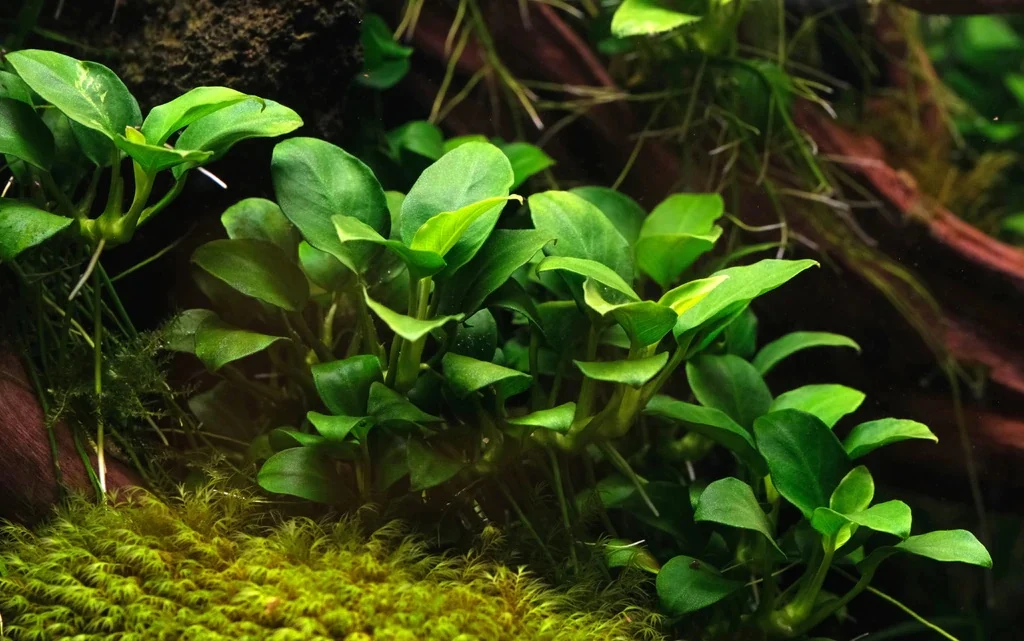
Most planted tanks you see in magazines run like race cars: pressurised CO2, powerful lights, daily fertiliser schedules. A low-tech tank is the bicycle by comparison - and that is a compliment. It asks for no gas bottles, no daily dosing and no constant trimming, yet it can still be a dense, green, living aquascape. The trade is speed: everything in a low-tech tank happens slowly, and the whole method is built around respecting that pace instead of fighting it.
This guide covers what low-tech really means, what growth you can honestly expect, and the handful of habits that keep these tanks thriving for years. If you have not set your tank up yet, start with our step-by-step planted tank setup guide first, then come back here for the low-tech way of running it.
What "low-tech" actually means
Low-tech is not a strict standard with a certificate. It simply describes a tank that runs without injected CO2, lit by modest light and fed lightly. Everything else - the filter, the substrate, the plants - can look exactly like any other planted tank.
The defining number is carbon. In any aquarium open to the air, dissolved CO2 settles at an equilibrium of roughly 2-3 ppm, topped up by fish respiration and the breakdown of organic waste. That is the entire carbon budget of a low-tech tank. An injected tank, by contrast, is usually run at around 20-30 ppm - roughly ten times more carbon on tap.
That single fact explains everything else in this guide. Plants in a low-tech tank are carbon-limited, so they grow slowly and need less light and less fertiliser than their high-tech cousins. Problems also develop slowly, which is why low-tech tanks have a reputation for being stable: you get weeks to notice and correct a mistake instead of days.
Set realistic growth expectations first
The most common reason beginners abandon low-tech tanks is not failure - it is expecting high-tech speed. Injected CO2 is powerful: The 2Hr Aquarist estimates that plants in an injected tank can grow 7-10 times faster than in a non-injected one. Run the maths in reverse and a low-tech stem plant that would need trimming weekly under CO2 might need trimming once a month for you.
In practice, a healthy low-tech tank looks like this:
- Fast stems (Limnophila, Hygrophila, pearl weed) add visible growth week to week.
- Rooted plants (crypts, swords, vallisneria) settle for a few weeks, then expand steadily for months.
- Slow plants (Anubias, Java fern, mosses) produce a new leaf or a bit of spread every few weeks. That is normal, not a deficiency.
- Pearling - streams of oxygen bubbles on leaves - is rare without CO2. Its absence does not mean your plants are unhappy.
| Low-tech | High-tech (injected CO2) | |
|---|---|---|
| CO2 available | ~2-3 ppm (natural equilibrium) | ~20-30 ppm (injected) |
| Light | Low, 6-8 hours a day | Medium to high, 7-10 hours |
| Growth speed | Slow and steady | Fast, sometimes rampant |
| Fertiliser | Light, about once a week | Frequent, often daily or near-daily |
| Trimming | Every few weeks | Weekly for fast stems |
| Plant palette | Easy, undemanding species | Almost anything, including fussy carpets and red stems |
Judge a low-tech tank monthly, not daily. Take a photo from the same angle on the same day each month - the difference that is invisible day to day becomes obvious, and it is the best motivation there is.
The light-first rule: low light, done right
If low-tech has one commandment, it is this: light is the accelerator, and carbon is the fuel tank. Your fuel tank is small and fixed at 2-3 ppm. Every extra unit of light asks plants to photosynthesise faster than that carbon supply allows - and the surplus light does not go to waste. Algae uses it instead.
So in a low-tech tank you set the light to match the carbon, not the other way round:
Intensity: keep it genuinely low
Measured with a PAR meter at the substrate, easy plants grow perfectly well at roughly 20-30 µmol, and anything under about 50 µmol at substrate level is generally classed as low light. Most beginners will never own a PAR meter, so use behaviour as your gauge: if the glass needs wiping more than once a week and algae films form on slow-growing leaves, the light is too strong for a no-CO2 tank - no matter what the box promised. Dim the light if it has a dimmer, raise it a few centimetres, or add floating plants to shade the water. All three work.
Duration: 6-8 hours, on a timer
Run the light for 6-8 hours a day. Start a new tank at 6 hours while plants are settling in, and move toward 7-8 hours once everything is growing cleanly. Ten or twelve hours of light "so the tank looks nice in the evening" is the single most common cause of algae in low-tech tanks. A plug-in timer or the light's built-in timer is not optional equipment - consistency is what lets plants settle into a rhythm. Some keepers split the day with a midday break (a "siesta"); it does no harm, but a single consistent block works just as well for most tanks.
Colour temperature is about looks
A daylight-looking light around 6,500-8,000K shows greens naturally and is what most planted-tank fixtures aim for. It is an aesthetic choice - plants care about intensity and duration far more than the exact shade of white.
A proven low-tech plant list, by position
Low-tech success is mostly decided at the shop, not at home. Choose species that evolved to sip carbon slowly, and the tank nearly runs itself. Every plant below is a long-standing low-tech staple. Our homepage plant finder lets you filter the full list by light level and position if you want more options.
| Position | Plant | Why it earns its place | Keep in mind |
|---|---|---|---|
| Background | Vallisneria (Vallisneria spiralis) | Tall ribbon leaves, spreads by runners, extremely hard to kill | Can shade smaller plants; trim leaves that lie along the surface |
| Background | Amazon sword (Echinodorus bleheri) | The classic centrepiece - big, green and hungry at the roots | Outgrows small tanks; needs root tabs in plain gravel or sand |
| Background | Limnophila sessiliflora | Feathery, fast stems that soak up nutrients and fill space quickly | The fastest plant here - expect regular trims |
| Midground | Cryptocoryne wendtii | As tough as crypts get; several leaf colours from one species group | Often melts back after planting, then regrows - patience required |
| Midground | Java fern (Microsorum pteropus) | Grows attached to wood and rock where nothing else will | Never bury the rhizome - tie or glue it to hardscape instead |
| Foreground / hardscape | Anubias barteri var. nana | Thick, dark leaves; almost indestructible; can flower underwater | Very slow - buy the biggest plant you can afford |
| Foreground | Dwarf sagittaria (Sagittaria subulata) | Grass-like runners that form a loose, natural carpet | Fills in over months, not weeks |
| Foreground | Staurogyne repens | Compact and bushy where most foreground plants are fussy | Slower without CO2; plant in small, well-spaced bunches |
| Foreground | Pearl weed (Hemianthus micranthemoides) | Can be trimmed into a soft, low carpet - rare in low-tech | Needs patience and regular trimming to stay low |
| Carpet (slow) | Monte Carlo (Micranthemum tweediei) | The easiest of the true carpet plants | In low-tech it creeps rather than carpets - a long-term project |
| Hardscape | Java moss (Taxiphyllum barbieri) | Covers wood and stone; shelter for shrimplets and fry | Looks messy if never trimmed - thin it and re-tie loose strands |
| Floating | Amazon frogbit (Limnobium laevigatum) | Shades the water and pulls nutrients fast - an algae ally | Thin it out weekly so it never covers the whole surface |
| Floating | Salvinia | Small, tidy floater that is easy to control | Keep an open patch of surface for gas exchange and feeding |
Two planting rules prevent most beginner losses. First, rhizome plants (Anubias, Java fern, Bucephalandra) must sit on top of the substrate, attached to wood or rock - bury the thick horizontal rhizome and it rots. Second, plant heavily from day one. A tank that starts 70-80% planted has plants outcompeting algae from the start; a sparse tank spends its first months losing that fight.
Substrate and root feeding
Here is the good news: low-tech does not require expensive aquasoil. Plain sand or fine gravel grows every plant on the list above, as long as the heavy root feeders get fed at the roots. Nutrient-rich aquasoils are a fine choice if you like them, but treat them as a convenience, not a requirement.
The plants split into two feeding camps:
- Root feeders - Amazon swords, crypts and vallisneria take most of their nutrition through substantial root systems. In an inert substrate they stall and yellow without help.
- Water-column feeders - stems, mosses, ferns, Anubias and floaters feed mainly from the water, which the liquid fertiliser section below covers.
For root feeders in sand or gravel, push a root tab deep into the substrate beside each plant, close to the root zone but not touching the crown. Tabs dissolve slowly; most keepers refresh them roughly every one to two months in an inert substrate - follow your product's guidance and watch the plants: a sword that stops producing new leaves is usually asking for a fresh tab, not more light. If you do use aquasoil, it feeds roots for the first year or so, after which tabs take over the job.
Liquid fertilizer: the light-touch approach
Fish waste and tap water supply some nutrients, but rarely all of them, and rarely in balance - potassium and iron are the usual gaps. A low-tech tank therefore still benefits from fertiliser; it just needs far less of it than a high-tech tank, because slow growth means slow consumption.
The routine that works for most low-tech tanks is deliberately boring:
- Use one all-in-one liquid fertiliser rather than a shelf of separate bottles.
- Dose once a week, right after the water change, so the week's level is predictable.
- Start at half the label dose. Increase only if you see genuine deficiency signs - pale new growth, pinholes in older leaves - not because the calendar says so.
The trap is generosity. In a carbon-limited tank, plants physically cannot use extra fertiliser, so the surplus sits in the water feeding algae. If algae is increasing, your first move is almost never "add something" - it is to check the light (too strong or too long) and only then look at dosing. Our planted tank fertilizer guide walks through root tabs versus liquids in more depth if you want the full picture.
Water changes and the weekly rhythm
Low-tech maintenance fits on an index card. Once a week, change roughly 20-30% of the water, wipe the front glass, check the filter is flowing, and dose the week's fertiliser. Most weeks that is 20 unhurried minutes.
The water change is doing three quiet jobs: exporting the organic waste and surplus nutrients that feed algae, replenishing the minerals and trace elements your tap water carries, and - most underrated of all - keeping conditions stable. Plants, crypts especially, dislike swings far more than they dislike imperfect-but-steady water. A modest change every week beats a heroic 60% rescue every month, every time. Match the new water's temperature roughly to the tank's, add your dechlorinator, and you are done.
Very mature, lightly stocked low-tech tanks sometimes stretch to a change every two weeks without complaint. That is a privilege a tank earns after months of stability, not a starting setting - begin weekly, and let the tank prove it can handle less.
Algae control is balance control
First, a reframe: a low-tech tank with zero algae does not exist, and chasing that goal causes more damage than algae ever will. A light film on the glass and a little fuzz on old leaves is a healthy tank's background noise. You intervene when algae starts covering plants or spreading fast - and the fix is almost always about balance, not chemicals.
Work the levers in this order:
- Light first. Green film returning to the glass within days means the light is too strong or too long for 2-3 ppm of carbon. Cut the photoperiod by an hour, dim or raise the light, and wait two weeks before judging.
- Plant mass second. More healthy plant growth is the most durable algae control there is. Fill gaps with fast stems and floaters rather than reaching for a bottle.
- Grazers third. A small clean-up crew that suits a planted tank - Amano shrimp, nerite snails, otocinclus - will graze film and soft algae off leaves and glass. They tidy; they do not fix an imbalance.
- Patience always. Change one variable at a time and give it about two weeks. Low-tech tanks respond slowly to corrections just as they deteriorate slowly - daily tinkering only muddies the evidence.
Skip algicide products as a routine tool. They can stress the very plants you are trying to protect, and since the underlying imbalance is untouched, the algae returns the moment the chemical wears off.
What NOT to buy for a low-tech tank
Low-tech is the cheapest way to run a planted tank, but shops will happily sell you the high-tech catalogue anyway. Save your money on:
- A powerful light. In a no-CO2 tank, a high-output fixture is an algae generator with a dimmer you will keep at 40%. Buy modest and spend the difference on plants.
- Demanding carpet plants. Dwarf baby tears (HC) and glossostigma need injected CO2 and strong light to carpet; in low-tech they melt, yellow and lift. Choose dwarf sagittaria or pearl weed instead.
- Fussy red stem plants. Most red species only colour up under high light and CO2. In low-tech they turn green at best. (Green is fine. Green is the house colour.)
- Dry-salt dosing kits. Bags of individual mineral salts belong to high-tech dosing regimes. One all-in-one bottle covers a low-tech tank for a year or more.
- "Liquid CO2" as a carbon strategy. Glutaraldehyde-based liquid carbon products are algaecide-adjacent supplements, not a substitute for CO2 gas - and a true low-tech tank does not need them at all.
- Cures for problems you don't have. UV sterilisers for green water, phosphate removers, algae eaters by the dozen - fix balance first; it is free.
Spend instead on the unglamorous things that decide outcomes: a timer, more plants than you think you need, a decent all-in-one fertiliser, and root tabs. And if one day you outgrow the low-tech pace - many do - the same tank can graduate: our beginner's guide to CO2 for planted tanks explains what changes when you add gas, and why the light has to change with it.