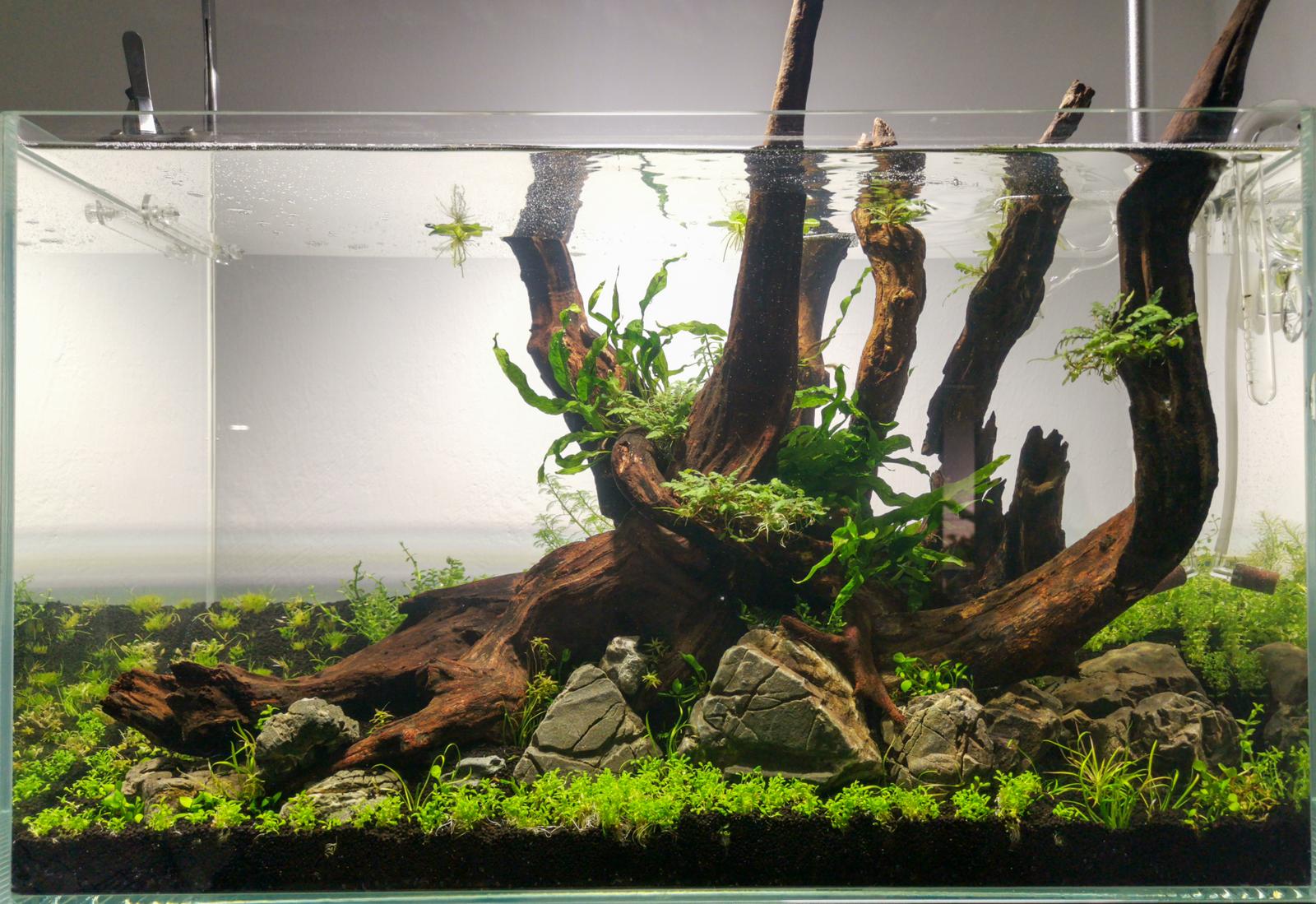
Why substrate matters more than beginners think
Substrate is the one piece of gear you cannot swap without tearing the whole tank down. Light, filter, fertilizer — all adjustable later. The substrate gets buried under roots, rock and wood in the first week, and by month three it has become the foundation of your ecosystem: a nutrient bank, a bacteria city, and the anchor holding every plant upright.
Get it right and plants root fast, stay rooted, and pull nutrients through their roots the way heavy feeders are built to do. Get it wrong — too shallow, too compacted, or nutrient-starved when your plant list is full of root feeders — and you'll spend a year fighting symptoms (pale leaves, floating stems, stunted carpets) that no amount of liquid fertilizer fully fixes. If you're still choosing your first plants, run your shortlist through our Plant Finder — it flags which species actually care about what's under them.
The two families: active soils vs inert substrates
Every option falls into one of two camps. Once you understand the trade-off, choosing gets much simpler.
Active (nutrient-rich) soils
These are baked-clay granules — "aquasoils" — loaded with nitrogen, phosphorus, potassium and trace elements, and they also buffer the water: they pull carbonate hardness down and settle pH into the low-6 range that most aquatic plants prefer. Plants like Amazon swords and cryptocorynes can look transformed in them compared to plain gravel. The catch: rich soils like ADA Amazonia release a noticeable amount of ammonia for the first few weeks, so livestock has to wait until the tank is fully cycled. They also have a finite lifespan — the nutrient charge depletes over time (more on that below).
Inert substrates
Gravel, sand, baked-clay products like Seachem Flourite: these provide structure and surface area for bacteria but no meaningful nutrition, and they don't alter your water chemistry. The upside is stability — no ammonia spike, no pH swing, nothing to expire. The downside is that root feeders need help: root tabs pushed into the bed near heavy feeders, plus liquid fertilizer for the water column. Plenty of beautiful planted tanks run entirely on inert substrate. It just shifts the work from "manage a rich soil" to "feed the roots on a schedule."
Beginner-friendly options, head to head
| Substrate | Type | Beginner fit | Watch out for |
|---|---|---|---|
| ADA Amazonia | Active soil | The gold standard for growth; pulls pH down into the low 6s | Strongest ammonia release when new — needs a patient cycle and frequent water changes |
| Tropica Aquarium Soil | Active soil | Similar performance to Amazonia; popular in Europe | Also leaches nutrients/ammonia early on — cycle before stocking |
| Fluval Stratum | Active soil (gentler) | A softer landing for first-timers: lighter, releases less ammonia | Granules are softer and can break down faster if handled roughly |
| UNS Controsoil | Active soil (gentler) | Low ammonia from the start; well-reviewed middle ground | Premium price for a gentler effect |
| Seachem Flourite | Inert baked clay | Never needs replacing; great structure for roots | Contains no nutrients — root tabs are mandatory for root feeders |
| Plain gravel + root tabs | Inert | Cheapest, endlessly available, zero surprises | Needs root tabs from day one; carpets root a bit slower |
| Coarse sand + root tabs | Inert | Natural look; carpets spread nicely across it | Fine sand can compact — stick to coarse grades and don't over-vacuum |
A note on what we deliberately left out: raw garden soil or potting mix capped with sand ("dirted" tanks) can grow plants beautifully, but it releases the strongest ammonia pulse of all, the chemistry is the least predictable, and only plain organic mixes are even candidates. For a beginner's first tank, commercial aquasoil does the same job with the guesswork removed. See the FAQ below if you're still curious.
How deep should the substrate be?
The widely agreed rule is 2–3 inches (5–7.5 cm) for most planted tanks — deep enough for roots to anchor and spread, shallow enough to avoid compacted dead zones. Fine-tune it by zone:
- Front: 1.5–2 inches. Thinner up front looks natural and keeps the front glass view clean.
- Back: 3–4 inches. The slope adds depth to the scape and gives tall background plants and heavy root feeders (swords, crypts) the depth they want.
- Under hardscape: pile it deep. Rocks and wood sit more naturally when partially buried, and the extra depth stabilizes them.
Going past about 4 inches of flat, undisturbed depth starts to risk anaerobic pockets — compacted zones without oxygen that can release unpleasant, toxic gases. If your scape needs real height, build the hill out of rock or mesh bags of lava rock first and drape a normal layer of substrate over it.
The ammonia phase: cycling an aquasoil tank
This is the part beginners fear most, and it's actually straightforward once you expect it. Rich aquasoils release ammonia when new — it's part of the design, not a defect. Treat the first month as a construction phase, not a finished aquarium:
- Add the soil dry and don't rinse it. Rinsing breaks the granules and dumps the nutrient charge all at once. Shape your slope, place hardscape, then fill slowly — a plate or plastic bag over the soil keeps the stream from cratering it.
- Plant heavily on day one. Fast-growing stems and a carpet start pulling ammonia and nutrients immediately, which is exactly what you want.
- Change water frequently. Large, regular water changes through the first 2–3 weeks dilute the ammonia and keep algae from exploiting the nutrient surplus. This is the single most important habit of the phase.
- Test, then stock. Add livestock only when ammonia and nitrite consistently read zero — typically around 3–6 weeks with a nutrient-rich soil, faster with gentler soils or seeded filter media. Our nitrogen cycle guide walks through the whole process step by step.
Gentler soils (Fluval Stratum, Controsoil) release noticeably less ammonia and can shorten the cycle, but the rule stays the same: test first, stock second.
The inert route, done right
If the ammonia phase sounds like more than you want for a first tank — especially with hard tap water, or fish that prefer higher pH — inert substrate is a perfectly good choice. Two rules make it work:
- Feed the roots from day one. Push a root tab near every heavy root feeder (swords, crypts, vallisneria) at setup, and replace them every couple of months. Anubias and java fern feed from the water column, so they mostly need liquid fertilizer instead.
- Don't over-vacuum. Hover the siphon over the surface to lift detritus; digging into the bed destroys the bacterial colonies doing your biological filtration. Inert substrate never "runs out" — it just needs to stay oxygenated and undisturbed.
Sand or gravel? For plants, both work. Coarse sand gives carpets something smooth to run across; gravel locks stems in place more securely. Pick the look you want — the plants will adapt either way, as long as the roots get fed. This route also pairs beautifully with a low-tech, no-CO₂ setup, where modest growth matches modest nutrient demand.
How long does aquasoil last?
Aquasoil is not forever, but it's not disposable either. Two things fade, on different timelines:
- The nutrient charge depletes first — heavily planted tanks can draw it down noticeably within the first year. When new growth comes in pale and smaller despite good light and CO₂, and root tabs suddenly make a visible difference, the soil is telling you it's running low.
- The buffering capacity (pulling pH and KH down) typically lasts around 1–2 years in soft to moderately hard water. With very hard tap water, expect it to exhaust much sooner — the soil fights your water chemistry constantly and loses.
Neither expiration is an emergency. A tired soil becomes, effectively, an inert substrate: keep it oxygenated, feed the roots with tabs, and keep the water column dosed with liquid fertilizer. Many aquascapers run soils for 2–3 years this way before doing a full rescape and replacing it. Fresh soil gives the biggest boost to new setups; old soil is still perfectly good structure.
What I'd actually buy: three scenarios
If you want a straight recommendation instead of more homework:
- Maximum growth, patient beginner: ADA Amazonia (or Tropica Aquarium Soil). Budget for a full fishless cycle and a test kit. This is the substrate behind most of the lush tanks you see online.
- Active soil without the drama: Fluval Stratum or UNS Controsoil. Less ammonia up front, still buffers softly acidic water, and friendlier to someone stocking sooner.
- Simple, cheap, hard water: coarse sand or fine gravel with root tabs from day one. No cycling drama, no pH swing, and your wallet barely notices. Pair it with undemanding plants from our Plant Finder and you may never miss aquasoil.
Whichever you choose, the rest of the formula doesn't change: decent light, consistent fertilizer, and a completed cycle. Substrate is the foundation — it doesn't replace the house. If plants start melting or yellowing after the switch, the troubleshooting guides will help you separate substrate problems from light, CO₂ and nutrient ones — holes in leaves, for example, are almost never a substrate issue.